 |
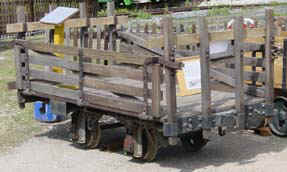
Preserved ex-Nocton Class 'P' ration wagon. Seen at the Amberley Chalk Pits museum, West Sussex Photo: B. Budd |
By Brian Budd
The Nocton Estate was established by W. Dennis & Sons in 1919 on 8000 acres of Lincolnshire Fenland. The primary activity of the estate was potato growing, but other produce included grain and sugar beet grown as part of the crop rotation system in use at the time. The estate also farmed livestock.
The Estate Manager, one Major Webber had seen effective use of light railways during his service in the Great War, and determined that this would be a suitable transport method within the estate due to the wet nature of the fenland terrain. This led to the purchase of track and rolling stock from an Army surplus depot at Arras, France.
In 1920 the first 4 miles of 1ft 11.5” track was laid and worked by horse and hand. Subsequently this was extended to serve every field in the estate and reach an interchange with the main line railway near Nocton & Dunston station – a total of almost 23 miles of single track. This was laid using 20lb/yd ex-WDLR track.
The line’s motive power consisted of five 20hp Petrol Simplex locomotives: four of the bow-frame style and one straight framed. These were purchased new for the line and were not ex-WDLR. In the 1930’s these were re-engined with diesel engines, and a sixth diesel Simplex was added to the fleet. During busy times in the early 1930’s, an additional locomotive was hired from Ruston & Hornsby during busy times.
|
Preserved ex-Nocton Class 'P' ration wagon. Seen at the Amberley Chalk Pits museum, West Sussex Photo: B. Budd |
All of the line’s loco-hauled rolling stock was ex-WDLR, initially consisting of some thirty-two 4-wheel ration wagons converted locally to open wagons with a capacity of 1.25 tons. These were formed in to permanently coupled rakes of four, each rake being allocated a single running number. Some ration wagons were converted to guard’s vans that included letterboxes to extend postal services to remote farms.
Later, fifty-three open bogie wagons were added to the fleet, these being of WDLR Class “D” (drop-side) and Class “E” (well wagon with sides). These were a mixture of wood and steel underframe versions.
Twelve ex-Ambulance vans were also used, providing box vans each with a 6-ton carrying capacity.
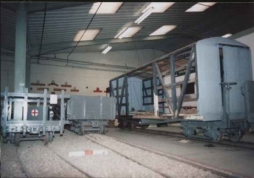 |
Preserved ex-Nocton Ambulance Van and Class 'D' open wagon Seen at the Museum of Army Transport, Beverley. Photo: G. Roberts |
Finally, five 2000-gallon water tank wagons were acquired for distribution of drinking water to cottages that were not connected to the village mains water supply. All of the wagons were painted light grey and carried their identity number in white on one side and one end.
Operationally the line was controlled in the same manner as the WDLR field railways. At the mill there was a large green baize covered board showing the estate plan. On this plan the railway route was shown and each field was numbered. For each wagon (or rake in the case of the four wheel wagons) there was a pin bearing the identity number. This pin was then placed on the board to show the location of that wagon.
For each wagon being dispatched a two-part docket was completed showing the quantity, type, weight and destination of the load, along with the wagon number. The controller retained one half of this, and the other attached to the wagon to notify the driver/guard of the wagon’s destination.
In 1958 700 yards of track, a Simplex locomotive, some bogie wagons and 4-wheel wagons were removed from Nocton to establish the Lincolnshire Coast Light Railway.
By 1960 the estate roadway network was such that lorries could access the fields directly, spelling the end of the major part of the railway. One loco and four bogie wagons were retained to operate a short piece of line serving the potato chitting house, surviving in this capacity until 1969.
In 1969 the railway closed, with three lorry-loads of track and wagons going on to further service at a fruit farm near Edinburgh, and the loco and some of the wagons going to the Lincolnshire Coast Light Railway.
Today examples of the rolling stock can be seen at a number of preservation sites including the Ffestiniog Railway and The Museum of Army Transport at Beverley.
Source: The Lincolnshire Potato Railways, Stuart Squires.
To contribute to this section please e-mail me (info(AT)wdlr.org.uk) - replace (AT) with @ to make address work.