For more information click here
Photo: Andrew Hughes


For more information click here.
Photo: Andrew Hughes
The Welsh Highland Railway, has a very interesting and complicated history. It is actually the product of several railways, some completed, some not. The first section of route built, known as the Croesor Tramway, was completed around 1863. It extended for 8 miles & 58 chains from Portmadoc to the upper end of the Croesor Valley.
Following the success of the newly introduced steam traction at the near by Ffestiniog Railway, The North Wales Narrow Gauge Railways Company was incorporated by an act of parliament in 1872. This was intended to be a huge network of lines totaling some 23 miles if all had been built. The initial concept was to construct the line, starting with a junction on the Croesor Tramway and extending via Beddgelert to Bettws-y-Coed. The next stage was the Moel Tryfan undertaking, consisting of 5 1/2 miles from Dinas to Bryngwyn, and then Tryfan Junction (on the Dinas-Bryngwyn line) to Rhyd-ddu in the parish of Beddgelert. By May 1877, the sections of line from Dinas to Bryngwyn, and from Tryfan Junction to Quellyn were open to Mineral & general goods traffic. Passenger services followed in the August. In June 1878 a further 3/4 mile section opened between Quellyn and Snowdon Ranger. The remaining 2 miles from Snowdon Ranger to Rhyd-ddu opened in May 1881.
Meanwhile, during the course of construction there had been a depression in the slate trade and the line was operating at a loss. In the early years, the NWNGR did not own its rolling stock, but hired the from an outside contractor, who's rentals fell into arrear. In 1878 the High Court appointed James Cholmeley Russell was appointed as a receiver. In 1885, an act was granted which gave powers to extend to Caernarvon Harbour, but the work was never completed (until 1997!) and the powers lapsed.
During this period, there had been many changes at the Portmadoc end of the route. The Croesor Tramway had applied for powers to build a 4 mile extension to Beddgelert. For various reasons this was not proceeded with. In 1901 an agreement was reached between the owners of the Croesor Tramway and the promoters of a new scheme who proposed to buy the Croesor line, electrify it, and build a branch to Beddgellert. This scheme was santioned by an act in August 1901 which incorporated the Portmadoc, Beddgelert & South Snowdon (Rhydd-ddu) Railway Company. In 1904 a further act was granted to allow the PBSSR to extend from Dinas to Caernarvon. By 1914, before War was declared, the route still consisted of the horse drawn Croesor Tramway to Portmadoc, and the steam loco operated NWNGR section. Any of the various schemes were put on hold during the Great War.
In 1922 a new company was incorporated, called the Welsh Highland Railway (Light Railway) Company. It absorbed the undertakings of both the North Wales Narrow Gauge Railways Company and the Portmadoc, Beddgelert and South Snowdon Railway Company, and also the powers of the two companies so far as they related to any proposed railways between Portmadoc and Caernarvon. In 1922 work began on the new 8 3/4 mile section between South Snowdon and Croesor Junction. This whole line was opened for passenger traffic in June 1923. Thus the Welsh Highland Railway was (finally) born. When the through line opened in full, there was an acute shortage of motive power. As a short term solution, locomotives were borrowed from the Ffestiniog Railway.
It was realized in 1923 that a new locomotive was required, this arrived in the form of a standard WDLR Baldwin 4-6-0T 'LR590'. There was also a shortage of rolling stock when the WHR opened, some of this deficiency was made up from loaned Ffestinog material and the acquisition of 6 Hudson built 'toast track' coaches to War Department design.
For the next few years the line fought a precarious existence, following the decline in the slate industry & increasing competition from road born tourist traffic. In 1927 Lt. Col. H. F. Stephens was appointed as receiver. In 1934 following continuing losses, the whole concern was leased to the Ffestiniog Railway for a nominal sum. After a valiant battle, they were forced to surrender the lease in 1937. The whole concern was then just left dormant for a number of years, had WW2 not happened one can only speculate how long this situation would have lasted. In 1941, the Ministry of Supply requisitioned material to assist the war effort. By May 1942 the whole route (except for the Croesor Tramway) had been lifted.
Today, after may years of protracted negotiations the Welsh Highland Railway is again reopening. A new company, run by the Ffestiniong Railway is working from Dinas. The first section opened was Dinas - Caernarvon (using a former standard gauge line), then in September 2000 the line opened to Waunfawr. The Welsh Highland Railway Company (1964) has been working for many years to restore the route from the Portmadoc end. Currently they are about to extend to Pont Croesor.
|
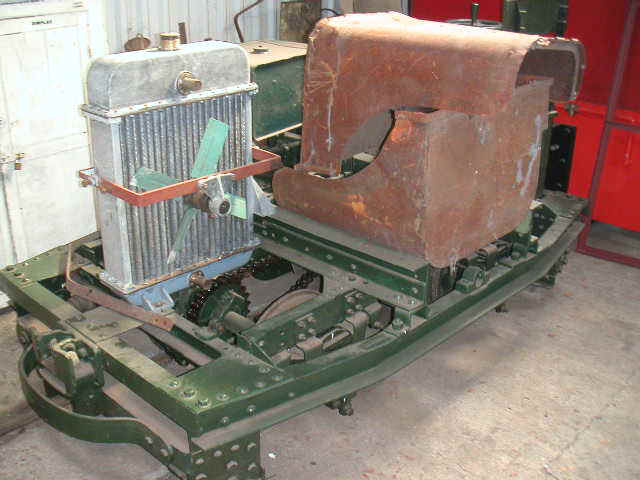
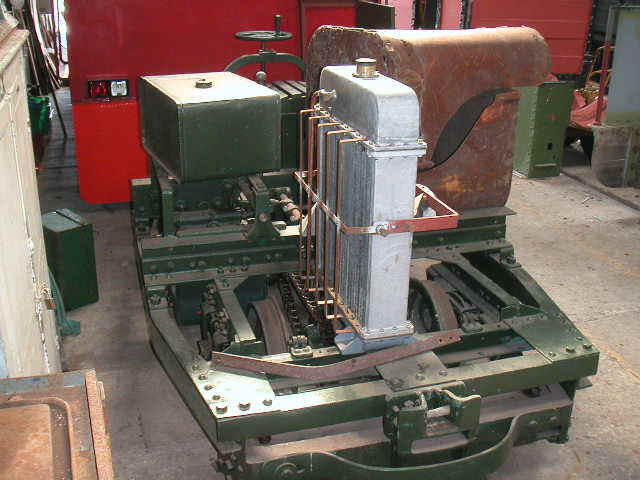
Currently undergoing a full restoration is this 20hp 'Bow-Frame' LR264 (assumed MR264
of 1916. For more information click here Photo: Andrew Hughes |
|
One of the original Hudson toastrack coaches has now returned to the Welsh Highland in
the form of #42, which is seen nearing completion at Gelerts Farm works. For more information click here. Photo: Andrew Hughes |
